
Are you tired of staring at hundreds of stock charts, trying to pick the next big winner, only to feel overwhelmed and uncertain?
The secret your broker won’t tell you? You don’t need to pick stocks to win. The sheer volume of choices in the Indian market is designed to overwhelm you, forcing you into a constant state of guessing. This pressure cooker environment causes two critical mistakes: over-concentrating your wealth in a few risky tickers or being so paralyzed by choices that you completely miss the market rally.”
The smartest path to long-term wealth doesn’t require complex research or daily trading; it requires Exchange Traded Funds (ETFs).
ETFs are simple, low-cost investment vehicles that allow you to buy a basket of dozens of stocks (like the entire Nifty 50 or a high-growth sector) with a single click. In this guide, we cut through the confusion and present the ultimate shortcut: The 5 Best ETFs to buy now that automatically provide the broad diversification, ultra-low costs, and market-beating potential your portfolio deserves.
What is an ETF?
An Exchange-Traded Fund (ETF) is like a pre-made basket of investments (stocks, bonds, or even gold) that you can buy and sell on the stock exchange, just like a single company stock.
The Key takeaway: When you buy one ETF unit, you instantly get a tiny piece of dozens—or even hundreds—of different assets, giving you instant diversification without having to research and buy each one separately.
| Feature | Stocks | Exchange-Traded Funds (ETFs) |
| What You Own | Ownership stake in a single company (e.g., a share of Reliance or TCS). | A basket of many securities (stocks, bonds, commodities) that tracks an index (e.g., Nifty 50, S&P 500, or a specific sector). |
| Diversification | Low. Performance depends entirely on that one company. Requires buying many stocks for diversification. | High (Built-in). Risk is spread across all holdings in the basket. One poor performer won’t ruin the whole investment. |
| Risk Potential | Higher. Potential for huge gains if the company is a “winner,” but also high risk of significant loss if the company fails. | Lower/Moderate. Generally less volatile than individual stocks because the risk is spread out. |
| Research Effort | High. Requires constant research and analysis of company financials, management, and industry trends. | Low. You only need to research what the ETF tracks (e.g., “The top 50 Indian companies”). |
| Control | High. You have total control over what you buy and sell. | Low. The fund manager (or index rules) determines the exact holdings in the basket. |
| Cost | Typically only a brokerage/transaction fee. No recurring annual management fees (Expense Ratio). | Brokerage fee plus a small, recurring Expense Ratio (annual management fee), usually very low for popular ETFs. |
| Best For | Experienced investors with a high-risk tolerance and time for research, or those targeting specific high-growth companies. | Beginners, passive investors, or anyone seeking simple, broad, low-cost exposure to a market or sector. |
Criteria for choosing a best ETFs
- Low Expense Ratio : This is the most critical factor, especially for passive index-tracking ETFs. A credible ETF should not be expensive.
- High Liquidity/AUM : A large, actively traded ETF is inherently more reliable and easier to deal with.
- Tracking Error : The ETF’s primary job is to mirror the performance of its target index (its benchmark).
- Diversification : While an ETF is a distinct legal entity, the reputation of the issuer (the fund house) still matters.
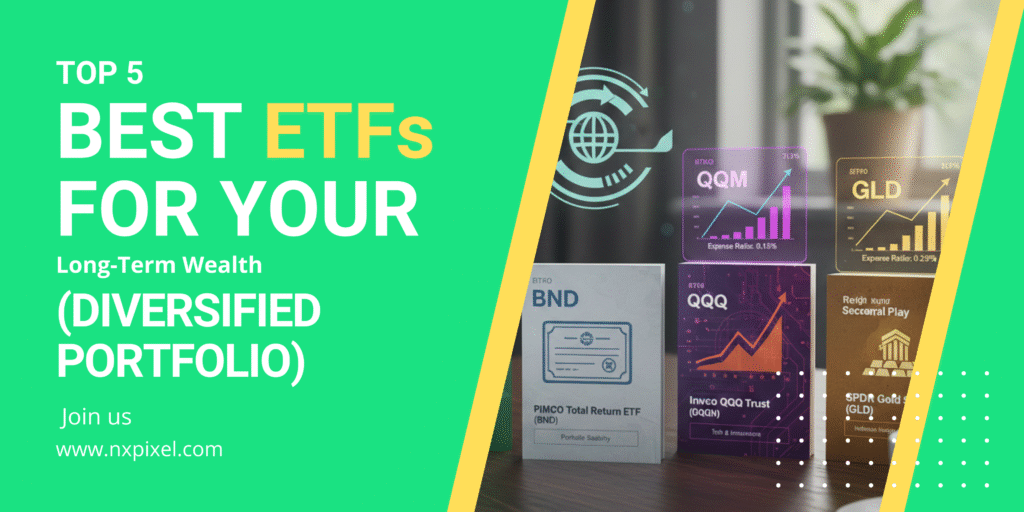
Top 5 Best ETFs to Buy Now
1. The Core/Benchmark: e.g., Nifty 50 ETF (Niftybees, etc.)
SBI Nifty 50 ETF
Ticker (Symbol): SETFNIF50
- AUM: ₹212119.00cr/-
- Expense Ratio: 0.04/-
- Key Advantage: Largest AUM – The largest fund size ensures high stability and low impact cost
Nippon India ETF Nifty 50 BeES
Ticker (Symbol): NIFTYBEES
- AUM: ₹53989.00cr/-
- Expense Ratio: 0.04/-
- Key Advantage: Highest Liquidity – Highest average daily trading volume, making entry/exit seamless.
ICICI Prudential Nifty 50 ETF
Ticker (Symbol): NIFTYIETF
- AUM: ₹34936.00cr/-
- Expense Ratio: 0.02/-
- Key Advantage: High AUM & Low Cost – Excellent balance of large fund size and competitive expense ratio.
2. The Next Growth Drivers: e.g., Nifty Next 50 ETF
Nippon India ETF Nifty Next 50 Junior BeES
Ticker (Symbol): JUNIORBEES
- AUM: ₹6867.00cr/-
- Expense Ratio: 0.17/-
- Key Advantage: Excellent liquidity ensures minimal impact cost when buying or selling large quantities.
ICICI Prudential Nifty Next 50 ETF
Ticker (Symbol): NEXT50IETF
- AUM: ₹1848.00cr/-
- Expense Ratio: 0.10/-
- Key Advantage: Known for a very low expense ratio (Total Expense Ratio or TER) which helps in maximizing returns over the long term.
SBI Nifty Next 50 ETF
Ticker (Symbol): SETFNN50
- AUM: ₹2683.00cr/-
- Expense Ratio: 0.12/-
- Key Advantage: A strong option backed by the reputation of SBI, often appealing to investors prioritizing established institutional presence and low cost.
3. The Mid-Cap Engine: e.g., Nifty Midcap 150 ETF
Mirae Asset Nifty Midcap 150 ETF
Ticker (Symbol): MIDCAPETF
- AUM: ₹1254.00cr/-
- Expense Ratio: 0.05/-
- Key Advantage: It often maintains one of the lowest expense ratios in this category, directly translating to higher net returns over the long run.
ICICI Prudential Nifty Midcap 150 ETF
Ticker (Symbol): MIDCAPIETF
- AUM: ₹835.68cr/-
- Expense Ratio: –
- Key Advantage: It typically has a very low tracking error (often reported around $0.03%), meaning it accurately replicates the index’s performance.
Nippon India ETF Nifty Midcap 150
Ticker (Symbol): MID150BEES
- AUM: ₹2693.00cr/-
- Expense Ratio: 0.21/-
- Key Advantage: It usually has the highest Assets Under Management (AUM), leading to strong daily trading volumes (liquidity).
4. The Global Diversifier: e.g., NASDAQ 100 or S&P 500 FoF (Fund of Fund)
Motilal Oswal S&P 500 Index Fund (FoF)
MF Fund (FOF)
- AUM: ₹4091.74cr/-
- Expense Ratio: 0.61/-
- Key Advantage: Broadest exposure to the US economy (500 large companies). Lower volatility than tech-heavy options.
Motilal Oswal NASDAQ 100 ETF
Ticker (Symbol): MON100
- AUM: ₹11317.00cr/-
- Expense Ratio: 0.58/-
- Key Advantage: Concentrated exposure to the 100 largest non-financial companies on Nasdaq. Excellent for US Tech giants (Apple, Microsoft, Amazon, etc.).
Mirae Asset NYSE FANG+ ETF
Ticker (Symbol): MAFANG
- AUM: ₹3652.00cr/-
- Expense Ratio: 0.65/-
- Key Advantage: Highly concentrated in ~10 mega-cap technology and high-growth stocks (e.g., FANG+ components). Highest potential return but also the highest risk/volatility.
5. The Non-Correlated Hedge: e.g., Gold BeES (Gold ETFs)
Nippon India ETF Gold BeES
Ticker (Symbol): GOLDBEES
- AUM: ₹32606.00cr/-
- Expense Ratio: 0.80/-
- Key Advantage: Superior Liquidity: As India’s largest and first Gold ETF, it has the highest trading volume, making it extremely easy to buy or sell units instantly without impacting the price.
HDFC Gold ETF
Ticker (Symbol): HDFCGOLD
- AUM: ₹15695.00cr/-
- Expense Ratio: 0.59/-
- Key Advantage: Its large fund size ensures stability and adequate liquidity. Historically maintains a low tracking error, which is key for a passive investment.
ICICI Prudential Gold ETF
Ticker (Symbol): GOLDIETF
- AUM: ₹11967.00cr/-
- Expense Ratio: 0.50/-
- Key Advantage: Often trades with high daily volume, second only to GOLDBEES in some metrics. Known for its operational efficiency in mirroring the underlying asset price.
Author Note:
I created this guide to provide a clear, data-driven starting point for your long-term investing journey. Please remember that I am not a certified financial advisor. The selection of these 5 ETFs is based on objective criteria (low cost, high liquidity, broad diversification), but they are examples—not personal recommendations for your specific portfolio. Your risk tolerance, time horizon, and financial goals are unique.