
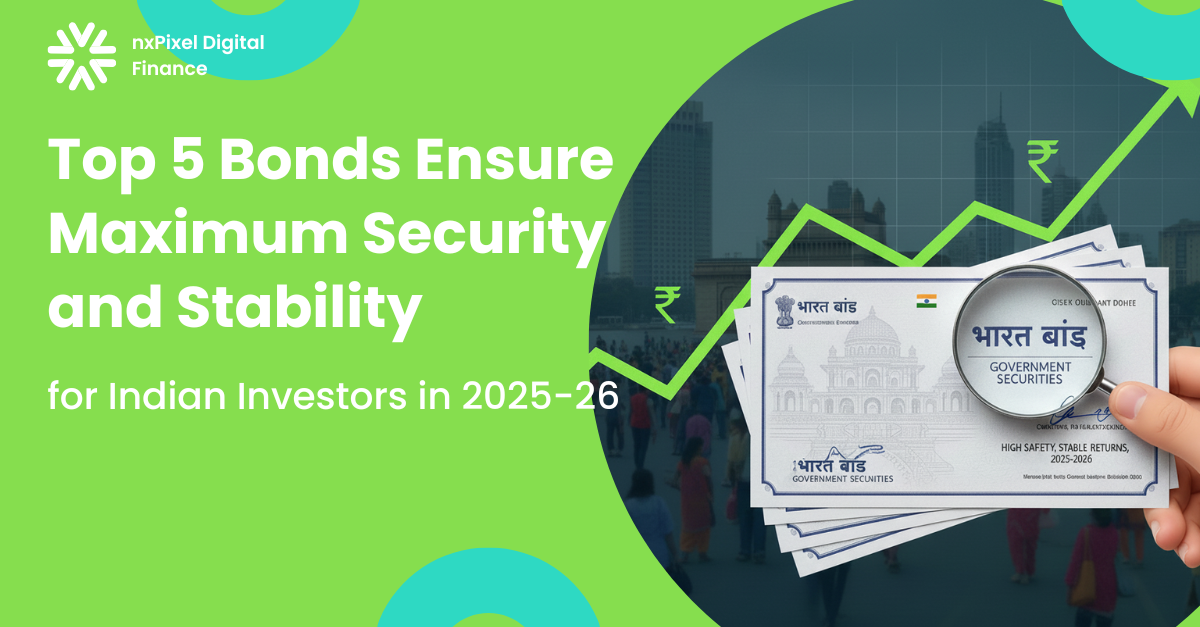
Real safety isn’t passive—it’s high-yield bonds. Find out why these 5 investments are the only way to beat inflation without the stock market gamble
Stop losing purchasing power! Your Fixed Deposits (FDs) might feel safe, but when you factor in inflation and taxes, are you really earning anything more than 1%? Meanwhile, the stock market volatility makes investing your core savings feel like gambling. The real problem for the conservative Indian investor is finding safety that actually beats inflation.
The solution is staring you right in the face: The Indian Bond Market. Currently, select AAA-rated and Government-backed bonds are offering yields higher than FDs, with far greater tax efficiency and stability than equities.
Risk vs Reward in Bonds
| Component | Definition | Example in Investing |
| Risk | The uncertainty or possibility that the actual return will be different (and usually less favorable) than the expected return, including the chance of losing the initial capital. | Default Risk (e.g., a corporate bond issuer failing to pay interest). |
| Reward | The potential gain, profit, or financial return (e.g., interest, capital gains, dividends) anticipated from the investment. | The Yield to Maturity (YTM) on a bond or the Capital Appreciation of a stock. |
In the context of the Indian investment landscape, assets fall along a continuum:
| Level | Asset Class (Indian Context) | Typical Risk Factors | Expected Reward |
| Low | Fixed Deposits (FDs), Government Securities (G-Secs) | Inflation risk, interest rate risk. | Low, stable, fixed returns. |
| Medium | AAA-rated Corporate Bonds, Large-Cap Equity Funds | Credit risk, market volatility. | Moderate, growth and income. |
| High | Small-Cap Stocks, High-Yield/Junk Bonds, Crypto Assets | Extreme market volatility, high default risk. | High, unpredictable, potential for significant loss. |
How Do We Choose the Best Bonds for Your Portfolio?
- Credit Rating: This is the single most important factor for safety and directly minimizes Credit Risk (the risk that the issuer defaults).
- Yield to Maturity (YTM): The YTM is the real annual rate of return you can expect if you hold the bond until maturity. This is far more important than the Coupon Rate. (Using YTM ensures the return calculation accounts for the bond’s current market price (discount or premium), giving the most accurate picture of your actual profitability.)
- Liquidity (The Accessibility Metric): In this criteria we ensuring can seller sell the bond quickly if they need cash? Low liquidity is a risk that often traps capital. [ Bonds that are listed and actively traded on the NSE or BSE, or those that have an established secondary trading platform (like RBI Retail Direct for G-Secs).]
- Maturity Alignment (The Risk Management Metric): The bond’s maturity period should match the your financial goal. Long-term bonds carry more Interest Rate Risk (price volatility when interest rates change). ( A mix of short-to-medium-term bonds (3–7 years) for better liquidity and lower interest rate risk.)
- Taxation Status (The Net Return Metric): High returns can be wiped out by high taxes. Focusing on tax-efficient bonds maximizes your net gain. A 7% Tax-Free return is often equivalent to a 10% taxable return for someone in the highest tax bracket, making it a far superior choice.
Top 5 Best Bonds
Here are the top 5 bonds I’ve chosen for you.
National Highways Authority of India
Returns (YTM): 7.13%
- Credit Rating: AAA/STABLE
- Remaining Tenure: 12Y 8M 16Days
- Min. Investment: ₹ 10,31,382.74
- Payment Terms: Yearly
- Why Choose This: NHAI bonds are a secure, government-backed choice for risk-averse investors seeking stable returns and a legal way to save on long-term capital gains tax from asset sales (like property).
POWER FINANCE CORPORATION LTD
Returns (YTM): 7.13%
- Credit Rating: AAA/STABLE
- Remaining Tenure: 10Y 1M 28Days
- Min. Investment: ₹ 3,18,520.26
- Payment Terms: Yearly
- Why Choose This: PFC bonds are an essential tool for wealth preservation and tax planning, chosen for their AAA safety, critical role in financing the Power sector, and effective use as a government-backed mechanism to save on Long-Term Capital Gains tax (54EC).
KERALA INFRASTRUCTURE INVESTMENT FUND BOARD
Returns (YTM): 9.51%
- Credit Rating: AA/STABLE
- Remaining Tenure: 6Y 8M 14Days
- Min. Investment: ₹ 1,02,738.48
- Payment Terms: Quarterly
- Why Choose This: KIIFB bonds offer conservative investors an appealing combination of high safety, guaranteed by the Government of Kerala, and attractive yields that generally exceed those of Central PSU bonds, allowing participation in Kerala’s infrastructure growth.
MUTHOOT MICROFIN LIMITED
Returns (YTM): 10.49%
- Credit Rating: A+/POSITIVE
- Remaining Tenure: 11M – 23M
- Min. Investment: ₹ 1,00,353.28
- Payment Terms: Monthly
- Why Choose This: MML bonds are chosen by us willing to accept a moderate risk (A+ rating) for significantly higher returns and more frequent interest payments than safer, AAA-rated government bonds.
ADANI ENERGY SOLUTIONS LIMITED
Returns (YTM): 8.42%
- Credit Rating: AA+/STABLE
- Remaining Tenure: 8Y 11M 19Days
- Min. Investment: ₹ 1,01,679.58
- Payment Terms: Yearly
- Why Choose This: We choose AESL bonds for the combination of a high AA+ credit rating and a higher coupon yield than AAA bonds, accepting the associated trade-off of higher company leverage and project execution risk, which is offset by the stability of its regulated utility business.
The Hidden Risks of Bond Investing
- Interest Rate Risk: This is the most critical risk for existing bondholders. It’s the risk that rising interest rates in the economy will cause the price of your existing bonds to fall in the secondary market.
- Inflation Risk: Inflation risk is the risk that the purchasing power of your bond’s fixed interest payments will decrease over time.
- Reinvestment Risk: Reinvestment risk is the possibility that you will be unable to reinvest the income or principal from a maturing bond at a rate of return as high as the original bond.
Disclaimer:
It concludes with a strong reiteration of the disclaimer: the content is not investment advice, and you must consult a certified financial planner as the analysis is based on data and regulatory structure as of the publication date.