
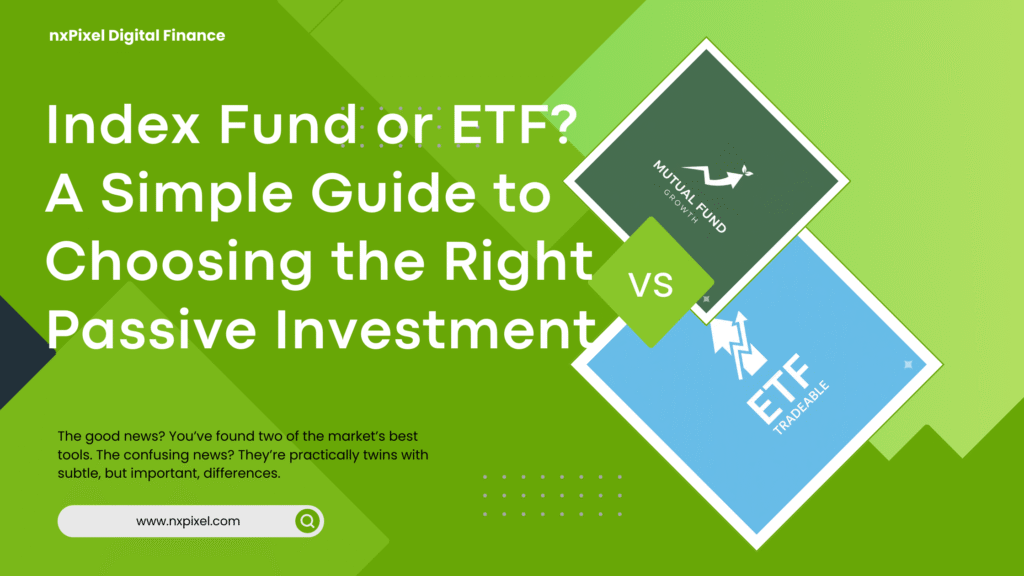
The good news? You’ve found two of the market’s best tools. The confusing news? They’re practically twins with subtle, but important, differences.
Stop losing sleep over investment complexity. You’ve heard the advice: Ditch the expensive, complicated mutual funds and embrace low-cost passive investing. Great! But then you hit the next wall: Should I choose an Index Fund or an ETF? You’re not alone. The subtle differences between these two wealth-building champions confuse millions of new investors. This simple guide will cut through the noise and give you a straightforward answer based on your investing style.
The main reason for choosing index funds and index ETFs is the conviction that trying to beat the market is difficult, expensive, and rarely succeeds over the long term.
- Low Cost is Key: Because they are passively managed (simply mirroring an index), these funds have much lower operating costs than actively managed funds. These lower fees compound over decades, giving them a significant advantage.
- Historical Performance: Research consistently shows that the majority of actively managed funds fail to outperform their benchmark index over long periods, especially once their higher fees are taken into account.
- Simplicity and Consistency: Passive funds offer a simple, diversified, and transparent way to capture the long-term growth of the overall stock market.
The strategy is not to find a winner, but to accept the consistent market return while maximizing the amount of that return you keep by minimizing fees.
What is Index Fund?
An Index Fund is a type of mutual fund or Exchange-Traded Fund (ETF) designed to replicate the performance of a specific market index, such as the S&P 500 or the Dow Jones Industrial Average.
It achieves this by holding the same securities (stocks or bonds) as the index, in the same proportions. Its goal is not to beat the market, but to capture the returns of the entire segment it tracks.
Key Features of Index Fund
| Feature | Explanation |
| Passive Management | The fund manager does not actively pick stocks or try to time the market. They simply follow the rules of the index. |
| Low Cost (Low Fees) | Because there is no need for expensive stock analysts and frequent trading, index funds typically have very low expense ratios (fees). |
| Instant Diversification | By investing in one fund, you instantly hold a small piece of every company in the index (e.g., 500 companies in the S&P 500). This spreads out risk. |
| Market-Matching Goal | The primary aim is to match the average market return over the long term, which historically beats the majority of expensive, actively managed funds after accounting for their high fees. |
Imagine the stock market is a giant pizza In Active Investing (Traditional Mutual Funds) scenario You hire an expensive “pizza picker” (the fund manager) who claims they can taste-test every slice and select only the absolute best ones for you. They charge a very high fee for this service. In other hand Index Fund (Passive Investing) scenario You decide you don’t need a pizza picker. You simply buy one small slice of every single flavor on the pizza (the entire market). Your slice will taste exactly like the average of the whole pizza, and the cost to you is extremely low.
What is The Exchange-Traded Fund (ETFs)?
An Exchange-Traded Fund (ETF) is a type of investment fund that holds a collection of assets—such as stocks, bonds, or commodities—and is divided into shares. Crucially, these shares trade on a stock exchange like regular stocks, meaning they can be bought and sold throughout the day at a fluctuating market price.
While ETFs can follow various strategies (active or passive), the most common and popular ETFs are index trackers, following the passive investing goal of matching a market index for a low fee.
Key Features ETFs
| Feature | Explanation |
| Intraday Trading | Unlike traditional mutual funds, which are priced only once after the market closes, ETFs can be bought and sold at any time during market hours. |
| Index Tracking (Common) | The majority of widely used ETFs are passively managed and aim to match the performance of a specific index (e.g., VOO, which tracks the S&P 500). |
| Low Expense Ratio | Because index-tracking ETFs are passively managed, they typically have very low management fees (expense ratios), maximizing investor returns. |
| Versatility | ETFs can track almost anything, from broad stock indexes and bonds to specific sectors, commodities (like gold), or even currencies. |
Imagine an ETF as a pre-built, themed basket of goods that you can buy and sell instantly at a store. The basket holds different items (stocks, bonds, etc.) that represent a specific category, like “The 500 Biggest Companies” (S&P 500) & Nifty 50. The store is open all day, and you can instantly buy or sell the entire pre-built basket, or just a few of its shares, at what ever price the market has set at that moment. You’re not trying to guess which individual item in the basket will be the best, you’re betting that the theme (The whole basket) will do well over time.
5 Key Differences of Index Fund And ETFs
| Feature | Index Fund (Mutual Fund) | ETF (Exchange-Traded Fund) |
| Trading Time | Once per day (at end-of-day NAV) | Throughout the trading day (real-time price) |
| Account Needed | Standard brokerage/fund account | Demat/Trading Account required |
| Buying/Selling | No brokerage fees (usually). No bid-ask spread. | Brokerage fees may apply (depends on broker). Has a bid-ask spread. |
| Automation (SIP) | Excellent; allows for Systematic Investment Plans (SIPs)/Auto-Invest. | Difficult/manual in many cases; generally cannot set up automatic dollar amounts. |
| Minimum Investment | Often has a minimum initial investment (₹500 – ₹1,00,000) or high SIP minimum. | As low as the price of one share (very low barrier to entry). |
The choice between an Index Fund and an ETF often comes down to your investment style, time horizon, and account type. Both are excellent, low-cost options for passive investing, but one may be more suitable for your specific needs.
1. Index Funds: Ideal for the Long-Term, Hands-Off Investor
Index Funds (Mutual Funds) are typically the better choice for investors who prioritize simplicity, automation, and investing fixed, small amounts regularly.
| Choose an Index Fund if you: |
| * Are a first-time or beginner investor looking for the easiest way to start. |
| * Plan to invest through a Systematic Investment Plan (SIP) with automated, recurring contributions. |
| * Want to invest small, fractional amounts regularly without worrying about brokerage fees for each transaction. |
| * Are a long-term buy-and-hold investor who does not plan to actively trade or time the market. |
| * Do not have a Demat/brokerage account or prefer to avoid the complexities of using one. |
| * Want to ensure your purchase price is always the official, fair Net Asset Value (NAV) of the fund. |
2. ETFs: Ideal for the Active, Flexible, and Cost-Conscious Investor
ETFs are better suited for investors who prefer real-time trading flexibility, have a brokerage account, and may need to time their transactions for specific market conditions.
| Choose an ETF if you: |
| * Already have a Demat/brokerage account and are comfortable placing trades like buying stocks. |
| * Want the lowest possible expense ratio (ETFs often have a slight edge in this area). |
| * Need the flexibility to trade throughout the day to capture specific price movements (intraday trading). |
| * Plan to invest lump sums or large, infrequent amounts, making the one-time trading cost minimal compared to the SIP cost over time. |
| * Want to employ more complex strategies, such as setting limit orders (buying or selling only when the price hits a certain point). |
| * Want to trade options based on the fund, as options are typically written on ETFs, not mutual funds. |
Both an Index Fund (Mutual Fund structure) and an Index ETF (Exchange-Traded Fund structure) are passively managed. And also their primary objective is not to beat the market, but to replicate the performance of a specific market index (like the S&P 500, Nifty 50, or a specific bond index) by holding the exact same securities in the same proportions. This passive strategy inherently provides broad diversification and keeps expense ratios (annual fees) very low compared to actively managed funds.
Also don’t forget to give your valuable feedback in comment section.